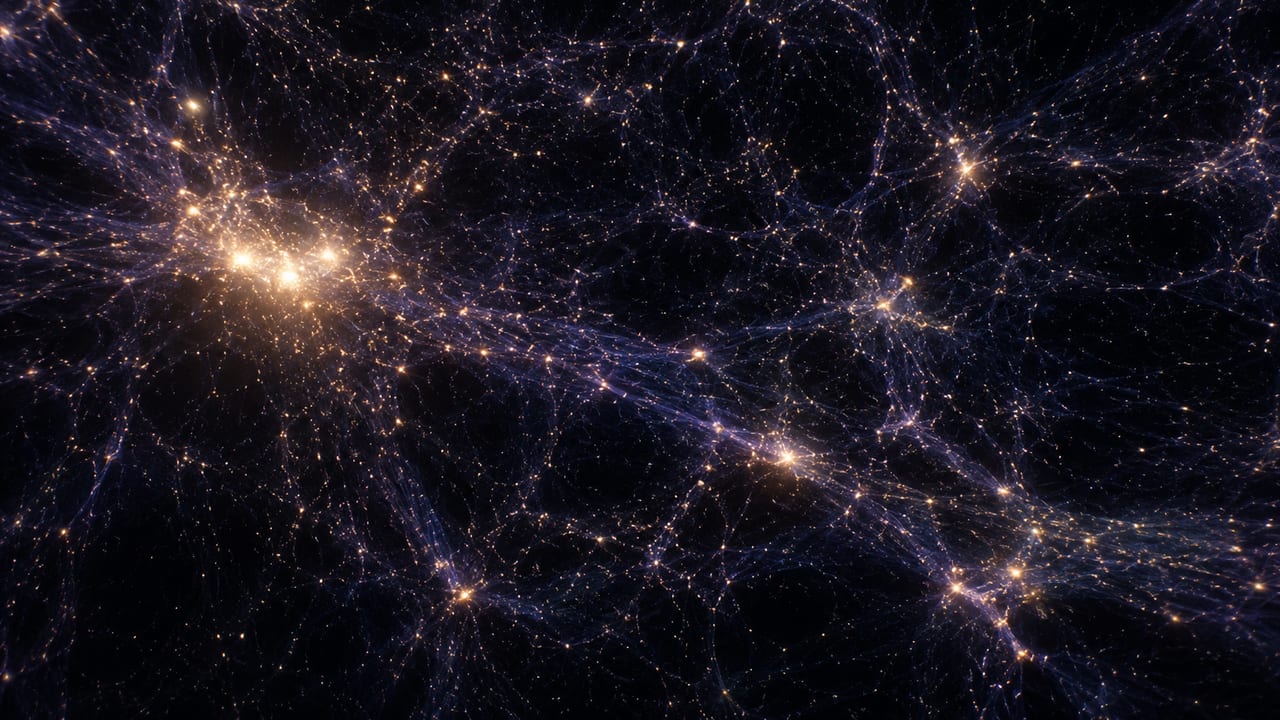
Cosmology · The Discovery Series

How we weighed
the entire universe.

We never put the cosmos on a scale. We watched how it moves and how its light bends — and discovered that 95% of what holds it together is something we have never seen.

Field  CosmologyEra  1933 – nowSubject  The cosmic budget
Read at your altitude
The Glance — the essence in twenty seconds

You cannot weigh a galaxy directly, so astronomers let gravity do it: the faster things orbit, the more mass must be pulling on them. Do this carefully and the visible stars and gas fall far short — galaxies behave as if wrapped in vast halos of unseen matter. Add the way light bends around clusters and the geometry of the infant universe, and the books only balance if ordinary matter is about 5% of the total, with roughly 27% "dark matter" and 68% "dark energy." We have weighed the universe with confidence — and found we cannot see almost any of it.
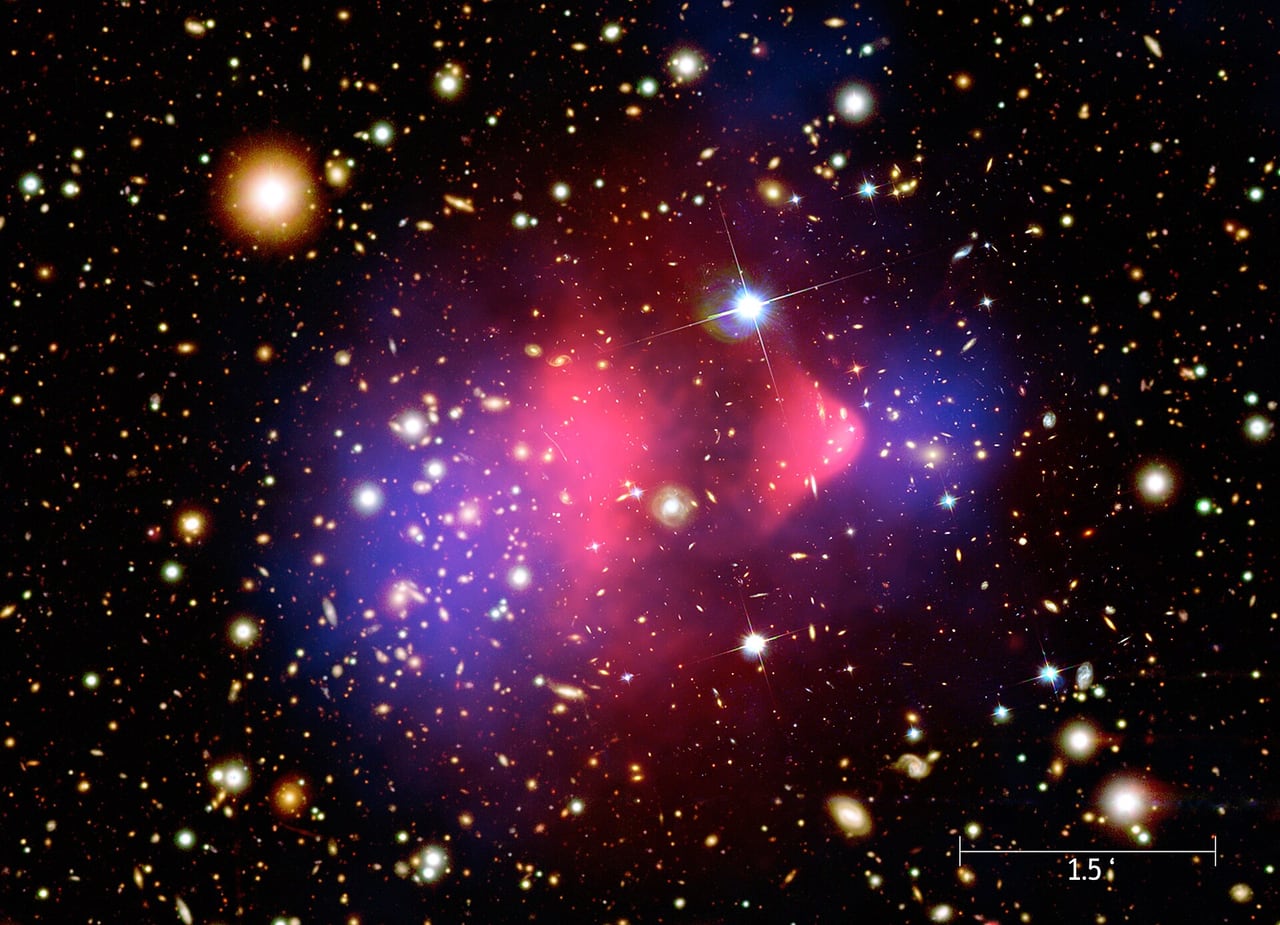
The Bullet Cluster: pink X-ray gas lagging behind two blue clumps of mass mapped by gravitational lensing.
The Bullet Cluster — two galaxy clusters that collided. The hot gas (pink, X-ray) was slowed by the impact, but most of the mass (blue, mapped by lensing) sailed straight through: dark matter, separated from the matter we can see. X-ray: NASA/CXC · Lensing: NASA/STScI, ESO, Magellan · Public domain
Why it matters

Independent methods, using completely different physics, all demand the same invisible 95%. That agreement is why dark matter and dark energy are taken seriously rather than dismissed.

Same discovery · depth 1 of 3

This is the identical fact set, re-told at a different altitude. Switch any time — the reader keeps your place in the idea, not the prose.

Sources & further reading

4 primary sources · checked against the original papers
  1. F. ZwickyDie Rotverschiebung von extragalaktischen NebelnHelvetica Physica Acta, 1933
  2. V. C. Rubin & W. K. FordRotation of the Andromeda Nebula from a Spectroscopic Survey of Emission RegionsThe Astrophysical Journal, 1970
  3. A. G. Riess et al.; S. Perlmutter et al.Evidence for an accelerating universe from Type Ia supernovaeAstron. J., 1998; Astrophys. J., 1999
  4. Planck CollaborationPlanck 2018 Results. VI. Cosmological ParametersAstronomy & Astrophysics, 2020

Celestium retells peer-reviewed science for a general audience. Where a claim rests on a specific result, the primary work is cited above — read it at the source.