Earth Science · The Discovery Series

The discovery that
the ground is moving.

A weather scientist noticed the continents fit together like torn pieces of paper, and proposed they drift. He was ridiculed for fifty years — until the seafloor itself was found to be keeping a record that proved him right.

Field  Earth ScienceEra  1912 – 1968Subject  Continental drift
Read at your altitude
The Glance — the essence in twenty seconds

Look at a map and South America seems to slot into Africa like two torn halves of a page. In 1912 Alfred Wegener argued this was no coincidence — the continents had once been joined and had since drifted apart. He had no force that could move them, so geologists dismissed the idea for half a century. The proof came from the bottom of the ocean: new seafloor erupts along undersea ridges and spreads outward, and as it cools it records the direction of Earth’s magnetic field. Because that field flips over geological time, the floor carries a striped barcode of reversals — and the stripes are mirror-symmetric about every ridge. The continents really do move, carried on vast plates.

MID-OCEAN RIDGEnew crust spreads both waysOLDER ←→ OLDER
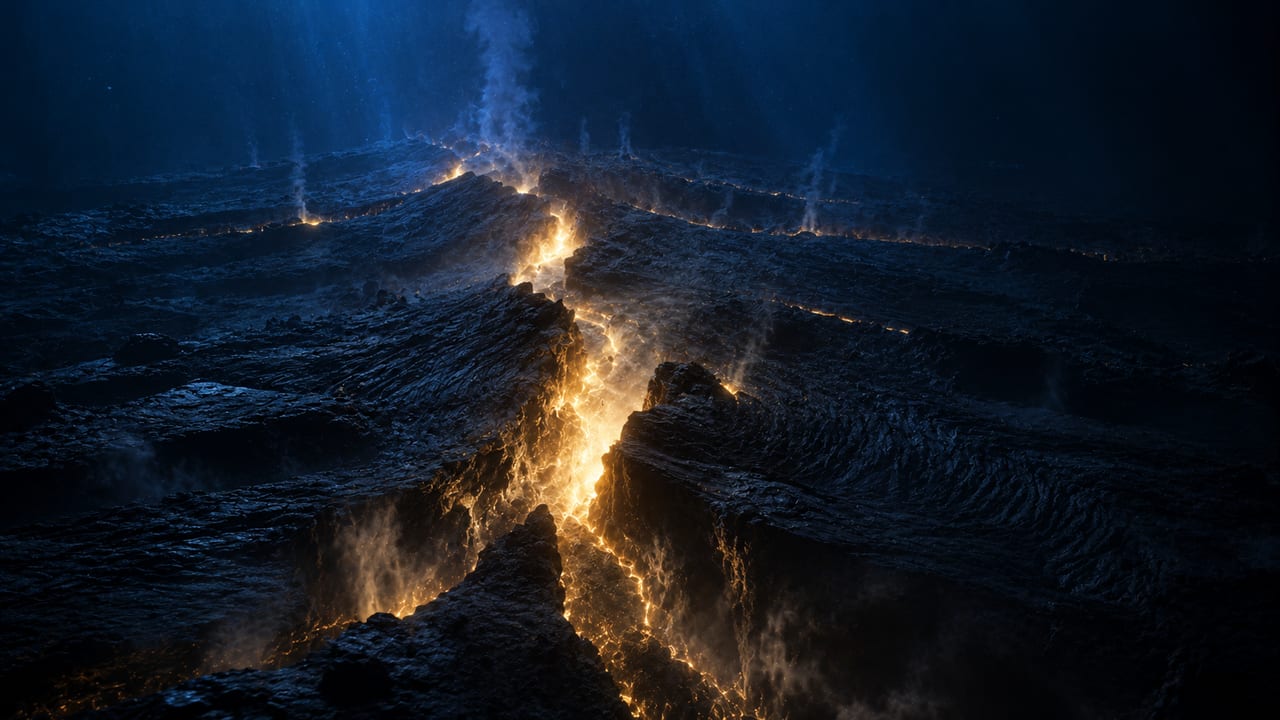
New seafloor erupts at the ridge and spreads outward, freezing the direction of Earth’s magnetic field into the rock as it cools. Because the field flips every so often, the floor records a barcode of reversals — mirror-identical on both sides. That symmetry is what proved the continents move.
Why it matters

It is the organising idea of all of geology. Earthquakes, volcanoes, mountain ranges and the slow rearrangement of the continents are all the visible edges of a few dozen rigid plates riding a churning interior.

Same discovery · depth 1 of 3

This is the identical fact set, re-told at a different altitude. Switch any time — the reader keeps your place in the idea, not the prose.

Sources & further reading

3 primary sources · checked against the original papers
  1. A. WegenerDie Entstehung der Kontinente und Ozeane (The Origin of Continents and Oceans)1915
  2. H. H. HessHistory of Ocean BasinsPetrologic Studies, Geological Society of America, 1962
  3. F. J. Vine & D. H. MatthewsMagnetic Anomalies over Oceanic RidgesNature, 1963

Celestium retells peer-reviewed science for a general audience. Where a claim rests on a specific result, the primary work is cited above — read it at the source.