Medicine · The Discovery Series

The mould that
beat infection.

A bacteriologist came back from holiday to a contaminated, ruined culture plate. Most people would have washed it. He looked closer — and found a mould that could kill the bacteria that, until then, routinely killed us.

Field  MedicineEra  1928 – 1945Subject  The first antibiotic
Read at your altitude
The Glance — the essence in twenty seconds

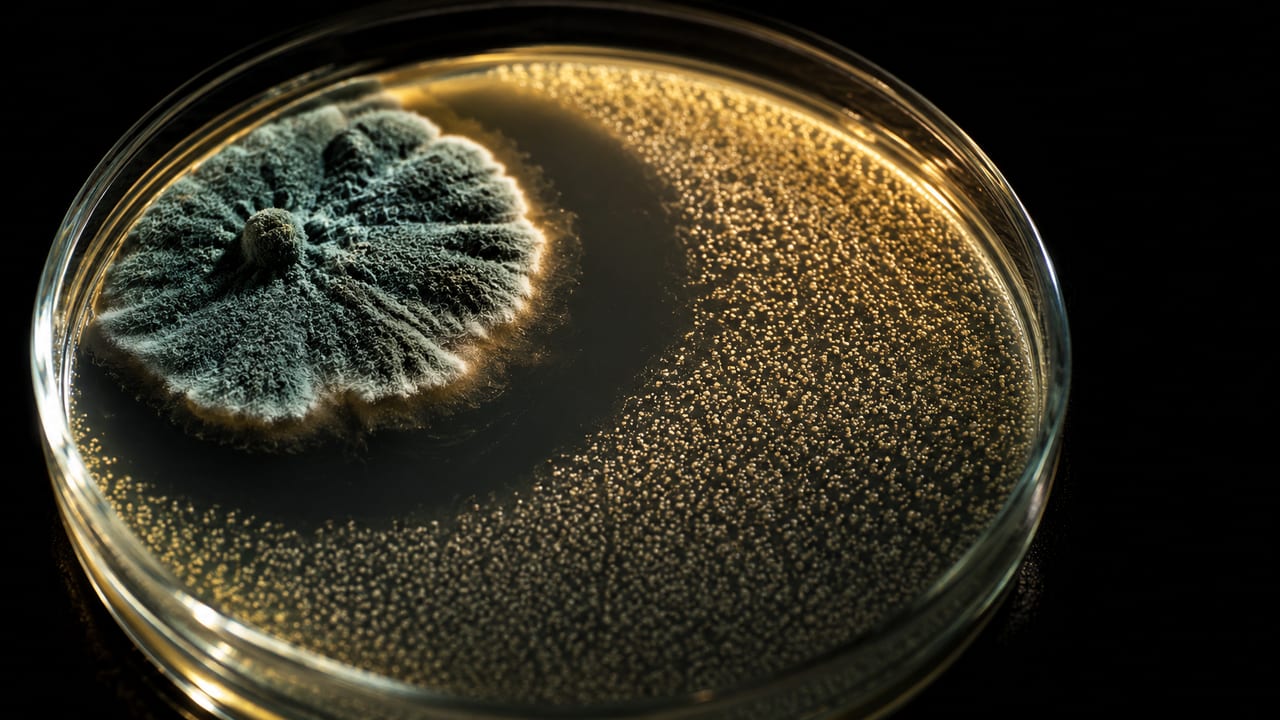
For all of history, a scratch or a chest infection could turn lethal, because nothing could stop bacteria once they took hold inside us. In 1928 Alexander Fleming noticed that a stray mould contaminating one of his culture plates had cleared a halo around itself where the bacteria simply would not grow. The mould, Penicillium, was releasing something that killed them. He called it penicillin. He could not purify it, and the discovery sat for a decade — until an Oxford team led by Howard Florey and Ernst Chain turned it into a medicine. It was the first antibiotic, and it changed what it means to be ill.

PENICILLIUMclear zone — nothing growsbacterial lawn
A dish seeded with bacteria grows as a haze everywhere — except in a clear moat around a stray speck of Penicillium. Something the mould released was killing the bacteria. Fleming noticed the gap; it became the first antibiotic.
Why it matters

Before antibiotics, ordinary infections — a cut, childbirth, pneumonia, surgery — were frequently death sentences. Penicillin opened the door to treating them, and to modern surgery, transplants and chemotherapy, which depend on holding infection at bay.

Same discovery · depth 1 of 3

This is the identical fact set, re-told at a different altitude. Switch any time — the reader keeps your place in the idea, not the prose.

Sources & further reading

3 primary sources · checked against the original papers
  1. A. FlemingOn the Antibacterial Action of Cultures of a Penicillium, with Special Reference to their Use in the Isolation of B. influenzæBritish Journal of Experimental Pathology, 1929
  2. E. Chain, H. W. Florey et al.Penicillin as a Chemotherapeutic AgentThe Lancet, 1940
  3. A. Fleming, E. Chain & H. FloreyThe Nobel Prize in Physiology or Medicineawarded 1945

Celestium retells peer-reviewed science for a general audience. Where a claim rests on a specific result, the primary work is cited above — read it at the source.