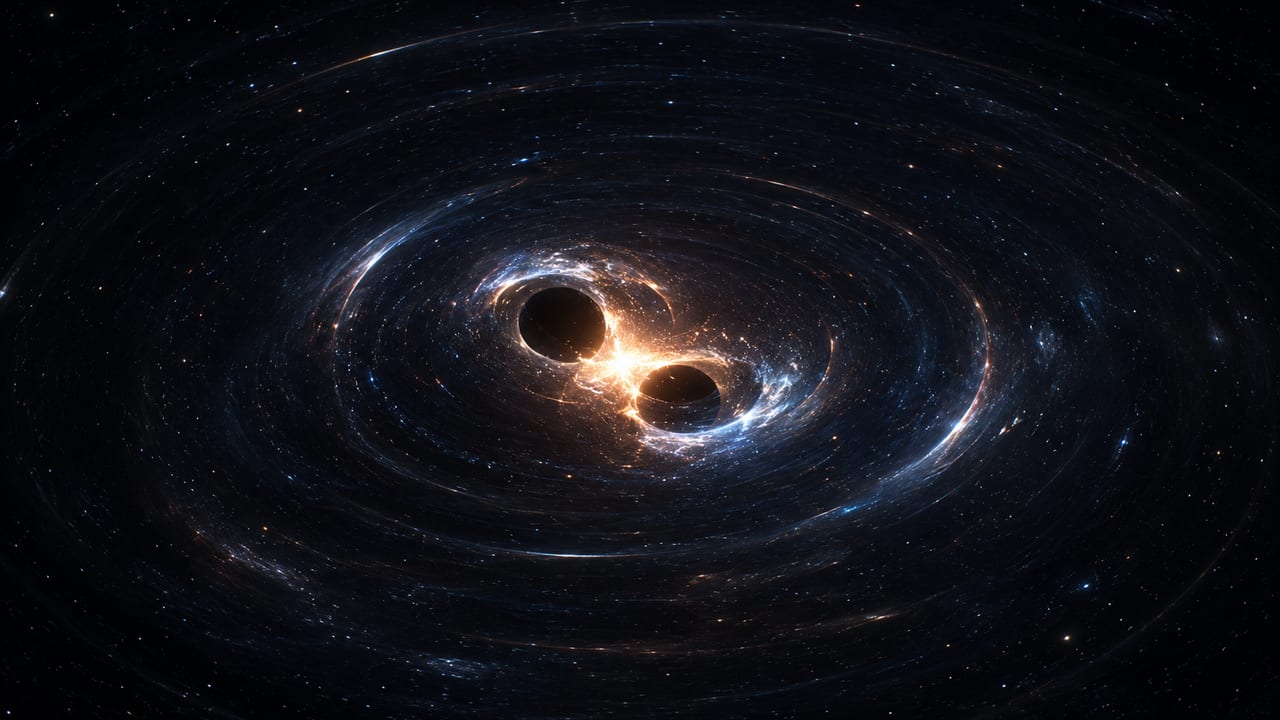
Astrophysics · The Discovery Series

The night we heard
two black holes collide.

A billion years ago two black holes spiralled together and shook spacetime itself. In September 2015 that tremor reached Earth and moved a mirror by less than the width of a proton.

Field  SpacetimeEra  2015 CESubject  GW150914 · 1.3B ly
Read at your altitude
The Glance — the essence in twenty seconds

Einstein predicted that violent events should send ripples through spacetime — gravitational waves — stretching and squeezing space as they pass. They are so faint he doubted they could ever be detected. On 14 September 2015 two detectors in the United States caught one: the merger of two black holes about 1.3 billion light-years away. The wave changed each detector’s 4-kilometre arms by about a ten-thousandth the width of a proton. It opened an entirely new way to observe the universe — by listening instead of looking.
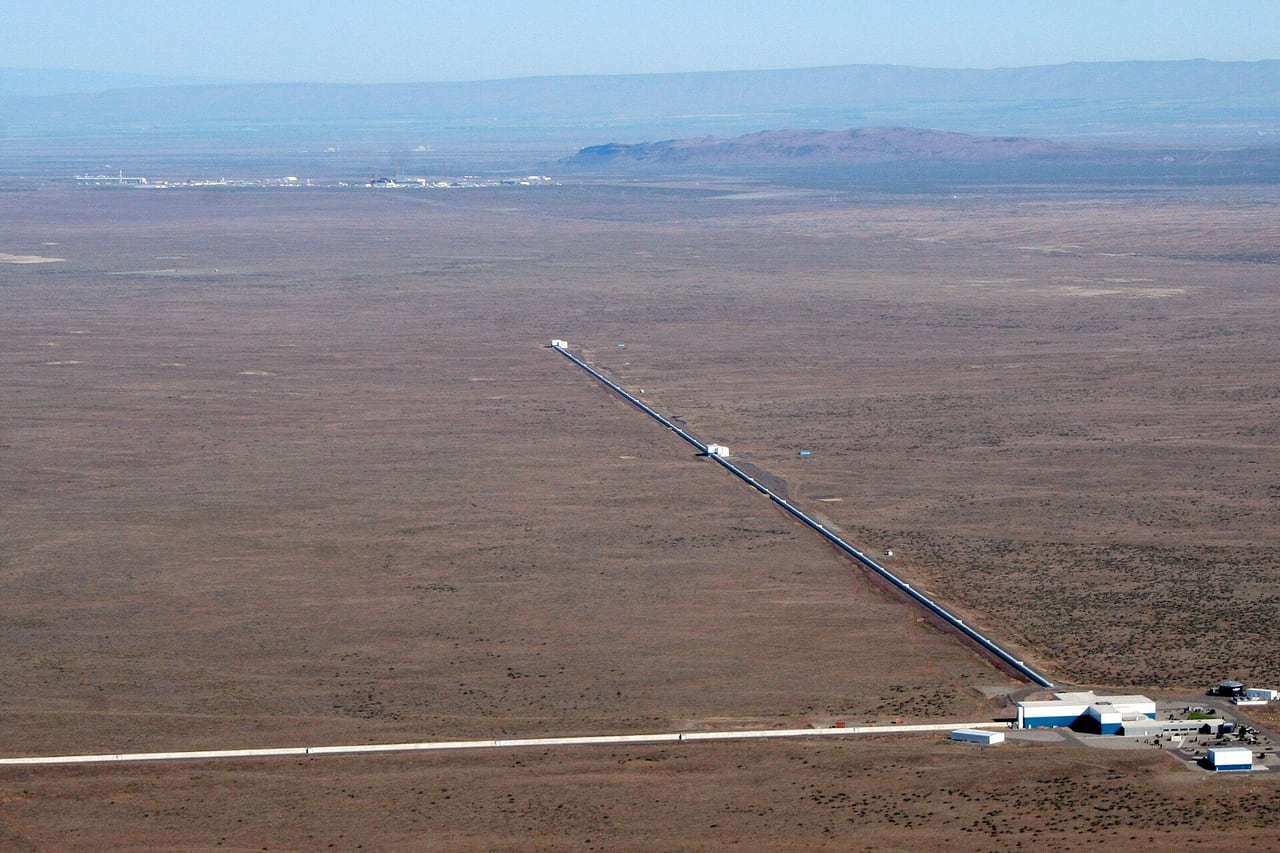
Aerial view of the LIGO Hanford Observatory: two four-kilometre arms meeting at a right angle in the desert.
LIGO Hanford, Washington — one of the two detectors. Each arm runs four kilometres; a passing gravitational wave changes their length by a ten-thousandth the width of a proton. Image: Caltech/MIT/LIGO Laboratory
INSPIRALMERGERRINGDOWN
The shape of the first detection, GW150914: frequency and amplitude both climb as the black holes spiral in, spike at the merger, then ring down. Played as sound it is a rising “whoop.”
Why it matters

Every telescope in history collected light. This was the first time humanity sensed the universe through gravity itself — and confirmed a 1916 prediction in the same instant.

Same discovery · depth 1 of 3

This is the identical fact set, re-told at a different altitude. Switch any time — the reader keeps your place in the idea, not the prose.

Sources & further reading

3 primary sources · checked against the original papers
  1. B. P. Abbott et al. (LIGO Scientific & Virgo Collaborations)Observation of Gravitational Waves from a Binary Black Hole MergerPhysical Review Letters, 2016
  2. B. P. Abbott et al.GW170817: Observation of Gravitational Waves from a Binary Neutron Star InspiralPhysical Review Letters, 2017
  3. R. Weiss, B. C. Barish & K. S. ThorneThe Nobel Prize in Physicsawarded 2017

Celestium retells peer-reviewed science for a general audience. Where a claim rests on a specific result, the primary work is cited above — read it at the source.