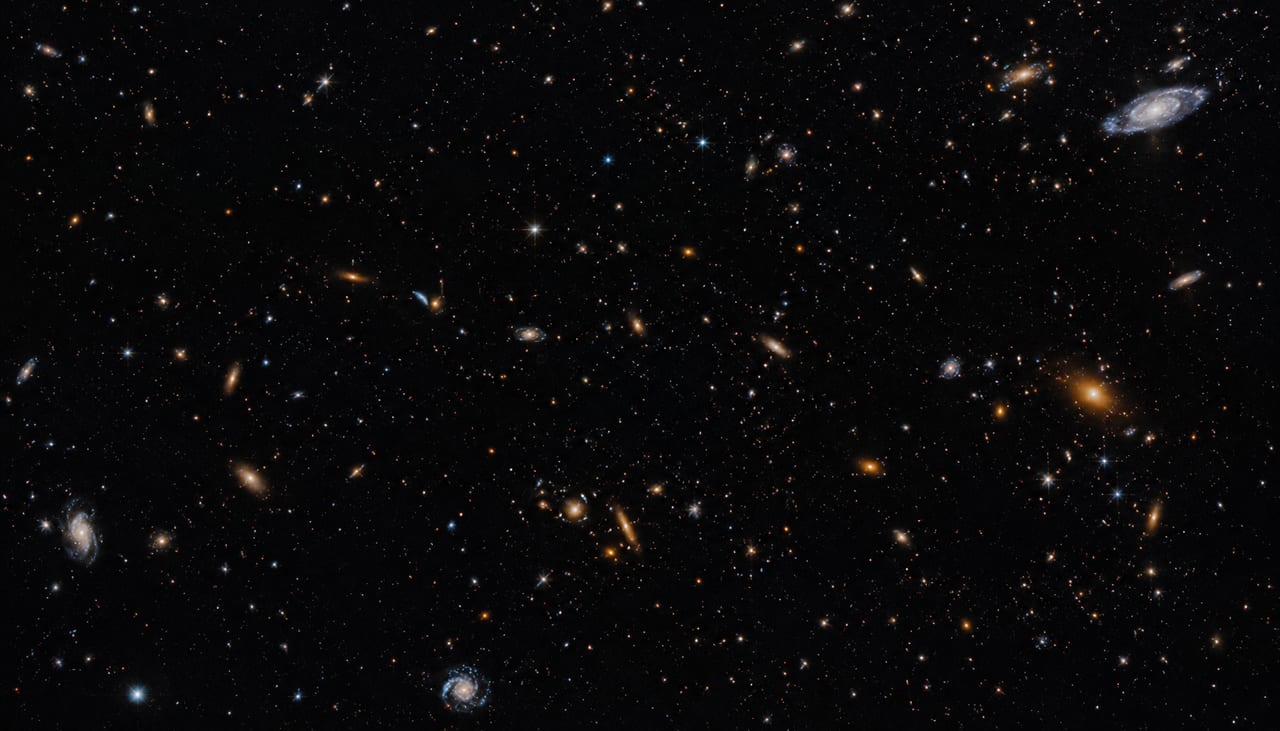
Light from a galaxy moving away from us is stretched to redder wavelengths, like a receding siren drops in pitch. In 1929 Edwin Hubble compared the distances of galaxies with these redshifts and found a clean rule: the farther a galaxy, the faster it recedes. There is only one way every galaxy can see all the others fleeing — space itself is expanding, carrying the galaxies apart. Run that expansion backwards and everything was once together: the seed of the Big Bang.
It overturned a universe believed to be static and eternal, and gave us a cosmos with a beginning and an age — about 13.8 billion years. Nearly all of modern cosmology starts here.
This is the identical fact set, re-told at a different altitude. Switch any time — the reader keeps your place in the idea, not the prose.