Quantum Reality · The Discovery Series

Does a particle exist
before you look?

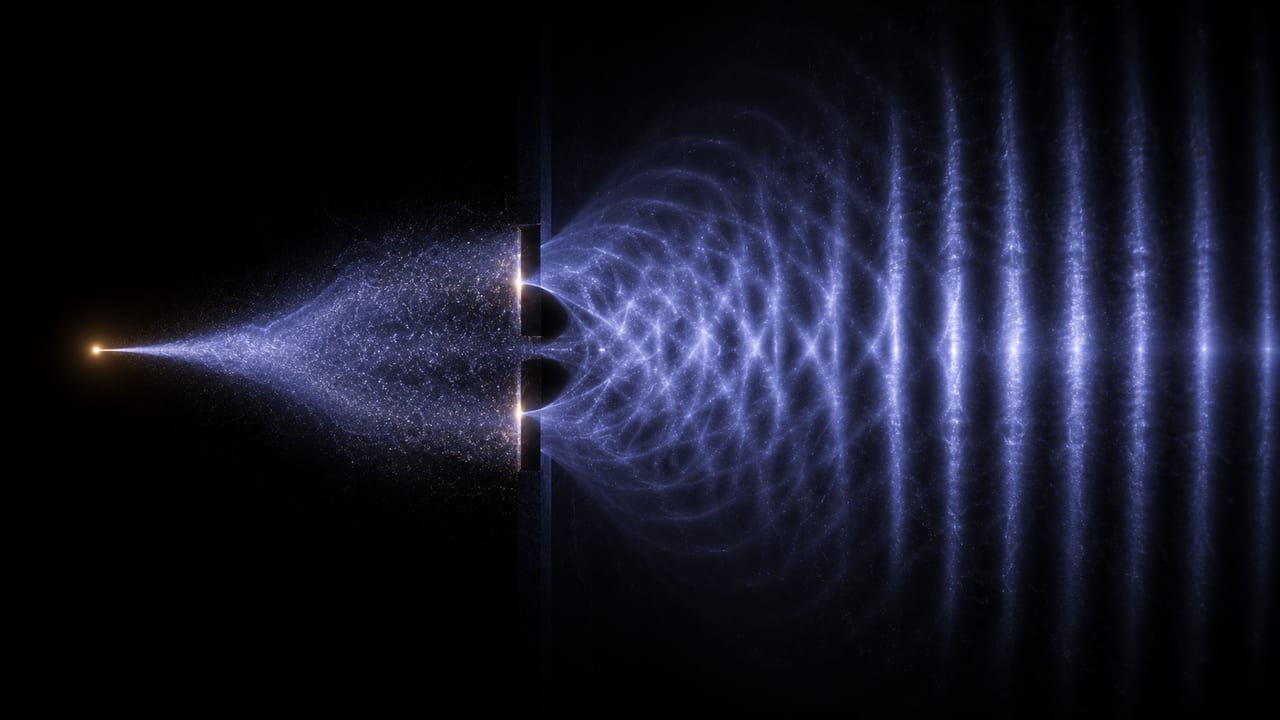
Fire single particles at a pair of slits and they build a pattern that only makes sense if each one passed through both at once. Try to catch which slit, and the pattern vanishes. A century on, the experiment still refuses to let reality be ordinary.

Field  Quantum RealityEra  1801 – nowSubject  The measurement problem
Read at your altitude
The Glance — the essence in twenty seconds

Shine light through two narrow slits and it makes a striped interference pattern — the signature of a wave. The strange part: fire the light one particle at a time, and each lands as a single dot, yet over thousands of shots the same stripes appear. Each particle behaves as if it went through both slits and interfered with itself. Place a detector to see which slit it really took, and the stripes disappear — it goes back to behaving like a plain particle. Before you measure it, a quantum object does not seem to have a single definite path at all.

SOURCETWO SLITSFRINGES
One particle, two open slits: the paths interfere and pile up into bright and dark bands. Close one slit, or record which slit it took, and the bands vanish.
Why it matters

It is the cleanest demonstration that the quantum world is not just small — it is built on different rules, where "where is it?" has no answer until you ask.

Same discovery · depth 1 of 3

This is the identical fact set, re-told at a different altitude. Switch any time — the reader keeps your place in the idea, not the prose.

Sources & further reading

4 primary sources · checked against the original papers
  1. T. YoungThe Bakerian Lecture: Experiments and Calculations Relative to Physical OpticsPhil. Trans. of the Royal Society, 1804
  2. M. BornZur Quantenmechanik der Stoßvorgänge (the probability interpretation)Zeitschrift für Physik, 1926
  3. C. Davisson & L. H. GermerDiffraction of Electrons by a Crystal of NickelPhysical Review, 1927
  4. A. Tonomura et al.Demonstration of single-electron buildup of an interference patternAmerican Journal of Physics, 1989

Celestium retells peer-reviewed science for a general audience. Where a claim rests on a specific result, the primary work is cited above — read it at the source.