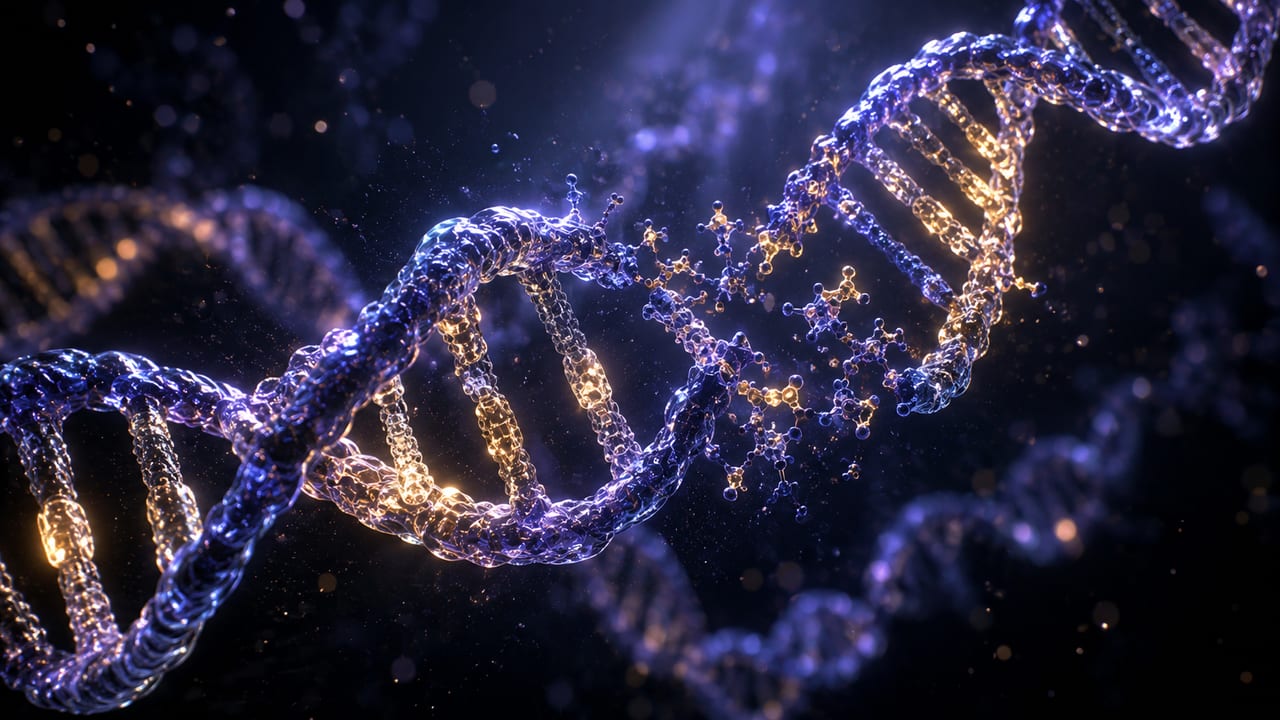
DNA carries the instructions for building a living thing, written along a molecule too small to see. In 1953 James Watson and Francis Crick — using a crucial X-ray image made by Rosalind Franklin — worked out its shape: two strands twisted into a double helix, their inward-facing chemical "letters" pairing up in a fixed way, A always with T and G always with C. That pairing was the punchline. Pull the two strands apart and each is a perfect template for rebuilding the other, so the molecule can copy itself. The structure did not just describe heredity; it explained it.
It united chemistry and life: heredity became something you could draw, with a mechanism you could see. Nearly all of modern biology and medicine descends from that one diagram.
This is the identical fact set, re-told at a different altitude. Switch any time — the reader keeps your place in the idea, not the prose.