Cosmology · The Discovery Series

We took a photograph
of the unphotographable.

A black hole emits no light by definition. In 2019, an Earth-sized instrument returned the first direct image of one anyway — and it looked exactly like a century-old equation said it would.

Field  CosmologyEra  2019 CESubject  M87* · 55M ly
Read at your altitude
The Glance — the essence in twenty seconds

A black hole traps light, so it cannot be seen directly. But the superheated gas swirling around one glows — and a black hole carves a dark, precisely-sized "shadow" out of that glow. In April 2019 the Event Horizon Telescope — eight radio dishes turned into one Earth-sized instrument — released the first image of that shadow, around the giant black hole in galaxy M87. Its size matched Einstein’s general relativity to within the error bars. In 2022 the same team imaged the one at the centre of our own galaxy.
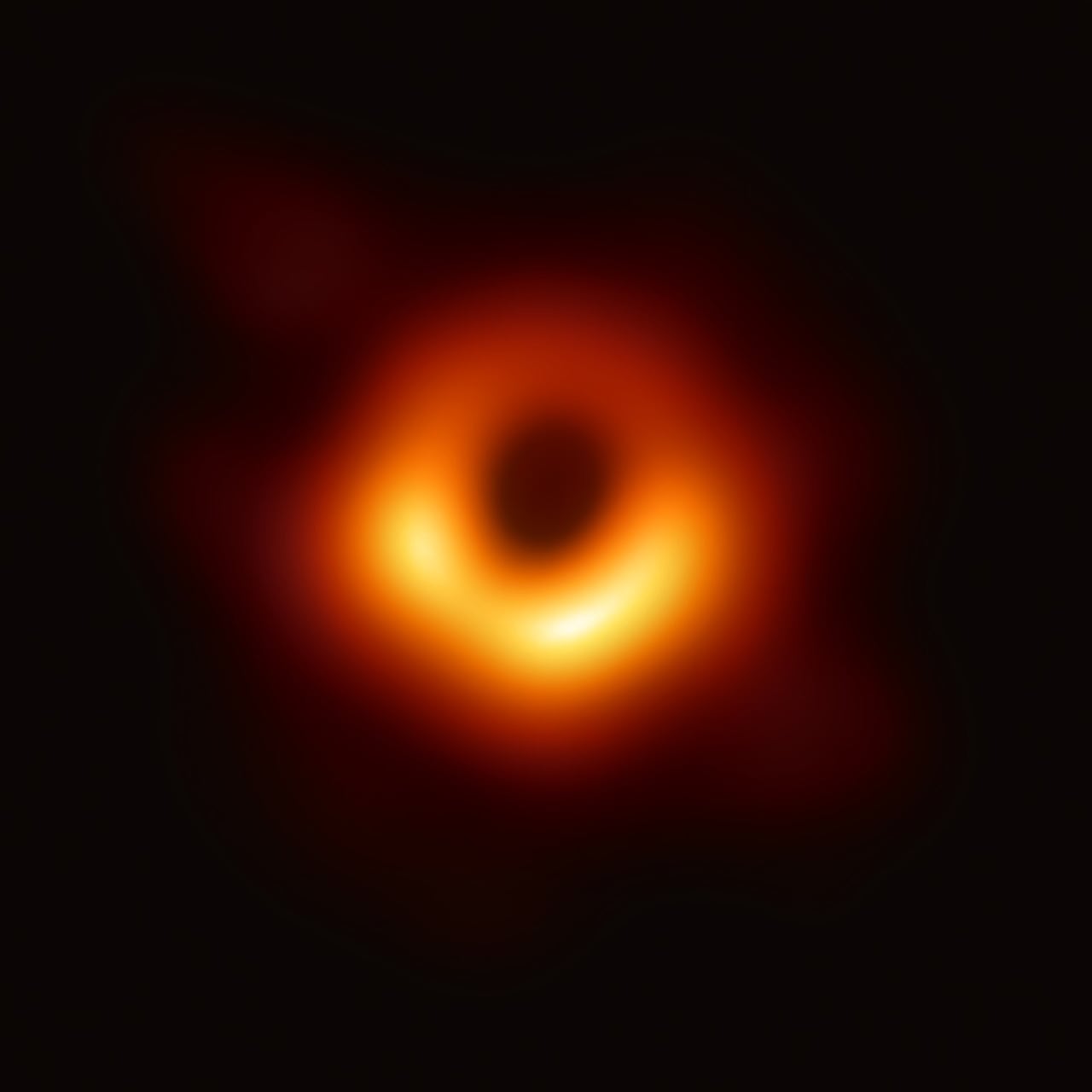
The Event Horizon Telescope’s 2019 image of M87*: a bright, slightly asymmetric orange ring of light around a dark central shadow.
The first photograph of a black hole — M87*, released 10 April 2019. The ring glows brighter where gas sweeps toward us at nearly light speed. Image: EHT Collaboration · CC BY 4.0
Why it matters

It turned a mathematical prediction from 1915 into a photograph. Nothing about the result had to come out right — and it did, exactly.

Same discovery · depth 1 of 3

This is the identical fact set, re-told at a different altitude. Switch any time — the reader keeps your place in the idea, not the prose.

Sources & further reading

3 primary sources · checked against the original papers
  1. Event Horizon Telescope CollaborationFirst M87 Event Horizon Telescope Results. I. The Shadow of the Supermassive Black HoleThe Astrophysical Journal Letters, 2019
  2. Event Horizon Telescope CollaborationFirst Sagittarius A* EHT Results. I. The Shadow of the Supermassive Black Hole in the Centre of the Milky WayThe Astrophysical Journal Letters, 2022
  3. A. EinsteinDie Grundlage der allgemeinen RelativitätstheorieAnnalen der Physik, 1916

Celestium retells peer-reviewed science for a general audience. Where a claim rests on a specific result, the primary work is cited above — read it at the source.